
Forestry Mulching in Lumberton, NC
With forestry mulching, a single tracked machine turns standing brush and small trees into a layer of mulch on the spot, leaving nothing to burn or haul off. Around Lumberton it's the usual tool for old fields grown up in pine and sweetgum, overgrown fence lines and ditch banks, hunting land, and wooded lots where you want to keep the big trees. Here's how it works, where it fits Robeson County's sandy ridges and wet bays, where it doesn't, what it costs, and when a permit can still come into it.
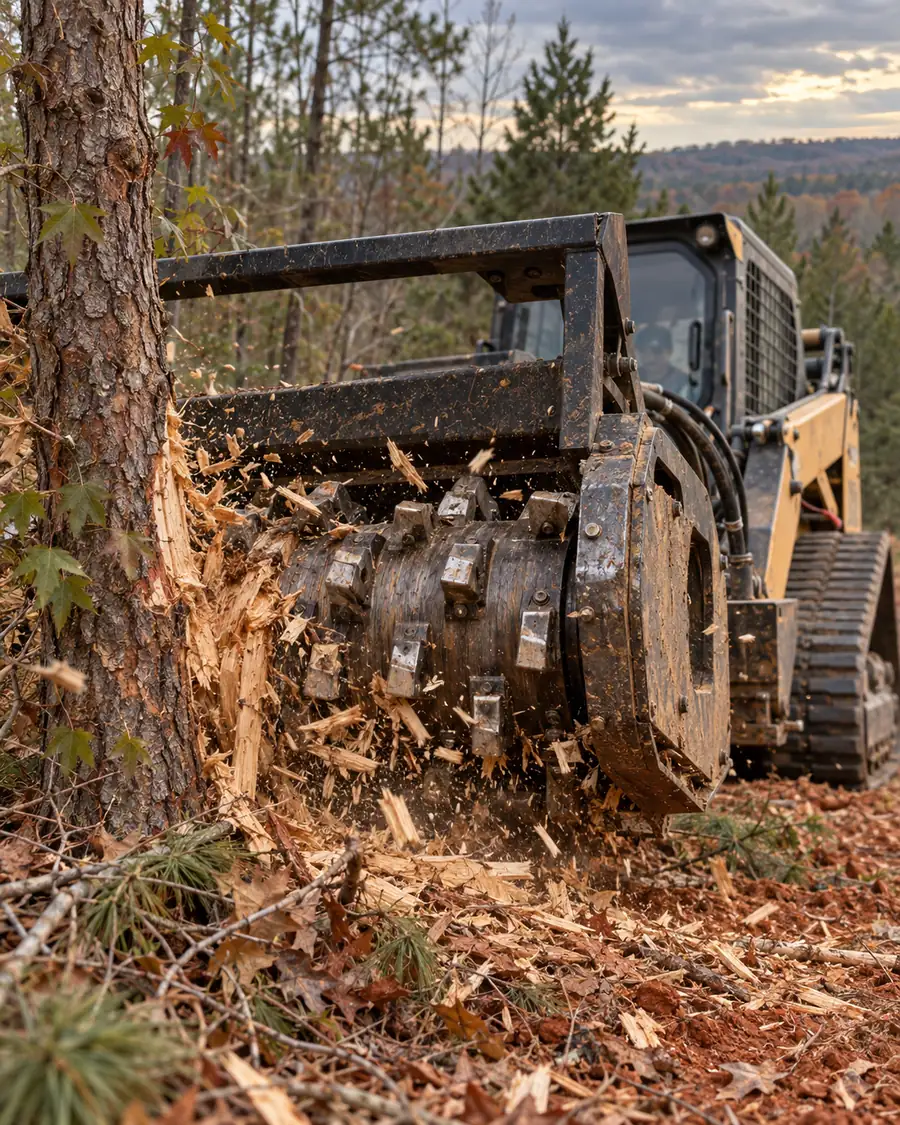
How it works
Picture a heavy drum studded with steel or carbide teeth, spinning on the front of a compact track loader, a skid steer, or a dedicated tracked carrier, or swinging at the end of an excavator arm. That's the mulching head. The operator eases it into standing brush and trees, it grinds them from the crown downward, and the shredded wood settles on the ground as mulch. No saw crew goes first, no burn pile gets built, and no dump truck hauls brush off the property. A single operator and machine do the job in one pass.
Compact-machine heads are generally sized for brush and stems up to roughly 6 to 8 inches across. High-flow machines and dedicated carriers swing bigger heads that take larger wood, and their hourly rate is higher to match. Past that size, a tree is either felled with a saw and fed to the mulcher in pieces, or the project becomes conventional clearing. It's worth asking each contractor what trunk diameter is comfortable for their machine.
Why it suits Robeson County land
Robeson County's comprehensive plan, citing the county soil survey, lists sandy soils like Lakeland, Wagram, and Norfolk next to soils that are "very poorly drained" in "depressions and bays on uplands," and notes that the county's swamps "eventually drain into the Lumber River." On ground like that, clearing lightly pays:
- Roots stay in. Since nothing gets pulled from the ground, a low spot doesn't end up with stump holes holding water, and sandy soil holds its structure.
- Nothing to burn. The state air rule requires land-clearing fires to be 500 feet from neighbors' occupied buildings, and outside town limits the NC Forest Service requires a permit for most burns. Mulching leaves nothing to burn. More on burn rules.
- The keepers stay. An operator can work around longleaf pines, shade oaks, and a tree line without cutting their roots. Inside Lumberton, the city's land use ordinance expects development to keep trees 18 inches across or more where it reasonably can.
- Old fields are mulcher work. Ground that grew up in young pine, sweetgum, and briars after farming stopped is mostly small stems, the size a mulcher handles best.
Typical mulching jobs around Lumberton
- Old fields and pasture edges grown up in pine, sweetgum, and briars. More on fields and brush.
- Fence lines, property lines, and ditch banks.
- Lanes, shooting lanes, food plots, and trails on hunting land.
- Cleaning up cutover after a timber harvest: slash, leftover small trees, and regrowth.
- Clearing the understory on a wooded lot before deciding where the house or home goes.
- Firebreaks along woods.
- Knocking back invasive plants. The NC Forest Service lists Chinese tallowtree, mimosa, Callery pear, autumn olive, kudzu, Chinese and Japanese wisteria, and Japanese honeysuckle among them.
When it's the wrong tool
- Under anything you'll build or set. Roots left in the ground rot and settle. A house pad, a manufactured home pad, a driveway base, or a septic drainfield needs stumps and roots grubbed out. Mulch the acreage; grub the footprint.
- On the septic area. Once Environmental Health has laid out your drainfield and its repair area, machines stay off both. North Carolina's septic rules bar disturbing or compacting the soil there; it "shall not occur over the initial and repair dispersal field area."
- Big timber. Most mulchers can't take mature pine and hardwood, and a real stand of it may be worth selling before anyone clears.
- Along the Lumber River in Lumberton. Within 100 feet of the river inside the city's jurisdiction, clear-cutting is prohibited and stumps and roots have to stay. Selective work for a view or access may be allowed; ask the city first. More on river lots.
- Saturated bays and muck. Wet organic soil swallows even tracked machines, so plan on waiting for a dry spell.
- When you need bare soil now. Under a deep mulch layer, seed can't reach the ground until the mulch is raked off or breaks down.
Regrowth
Mulching knocks hardwoods down; it doesn't kill them. Sweetgum regenerates from root sprouts, and red maple puts up sprouts two to six weeks after cutting, per the species guides published by the U.S. Forest Service. Pine is the exception: its cut stumps don't resprout, although seedlings blow in on the wind. Budget for mowing sprouts during the first year or two, a herbicide treatment on the worst species, or both. If a contractor offers to treat stumps or spray the regrowth, ask about their license, because applying pesticides for pay on someone else's property requires a North Carolina pesticide license.
What forestry mulching costs
Expect a price per acre, per day, or per machine hour. Knock'Em Down Solutions, a Fayetteville-area mulching operator that lists Lumberton in its service area, publishes "Full day $1,500" or "hourly from $200 (6 hr min)," with jobs under six hours at $300 an hour. Depending on density, national guides put mulching at $400 to $1,500 an acre (HomeAdvisor, June 2026) or $1,000 to $2,500 an acre (Angi, May 2026). Around Lumberton, the number moves with stem size and density, wet ground and lost weather days, the drive out to a rural address, the minimum on a small job, and the care it takes to work around keepers. Treat every figure here as a guide, not a quote for your land. More on cost.
Does mulching need a permit?
Sometimes. Check these:
- State erosion law. Disturbing more than one acre takes a written erosion and sedimentation control plan first. Erosion control itself is required, DEQ says, "regardless of the size of the disturbance." How the rules treat mulching that leaves the roots in the ground isn't spelled out in any official guidance, so if the job tops an acre, check with DEQ's Fayetteville Regional Office (910-433-3300) before work begins.
- Inside Lumberton. The city's land use ordinance counts "the removal of trees from a parcel of land" and clearing as development, which needs a zoning permit. Its exception: "Forestry or clearing and grubbing for active farming is permitted without a permit."
- In the county. County zoning "does not impose nor exercise any controls over croplands, timberlands, pasturelands," and no county clearing permit turned up in the ordinance.
- Flood zones and the river. Grading or fill in a mapped flood zone needs a floodplain permit, and the river buffer applies inside Lumberton's jurisdiction. Details here.
Forestry mulching questions
Will the mulch hurt my field?
A thin layer rots into the soil, and grass grows up through it. A deep layer locks up nitrogen while it decomposes, so new seed has a hard time until the mulch is raked, disked, or left a season. For lime and fertilizer, get a soil test; the county Extension center can help with that.
Can the contractor work around the trees I want to keep?
Yes. Mark the keepers with flagging and settle on how close the machine can get. Mulching doesn't disturb their roots.
How long does an acre take?
Density decides that much more than acreage does. A few hours may do for thin brush, while a thick stand of sweetgum and pine takes far longer, and wet ground drags out any job. Have the contractor estimate it in machine hours.
Should I cut the trees down first?
Generally, no. Mulchers are at their best on standing growth, and felled trunks lying in every direction slow the work. Ask the contractor first, before any saw comes out.
How we help
Let us know by phone or short request where the land is, about how many acres, and what's grown up on it, whether that's pine, sweetgum, briars, or a mix. One independent contractor who works in your part of Robeson County gets it, walks the land, and gives you a quote. Hire them or not, as you choose; there's no fee for the referral.
Want a local contractor to walk your land?
Call or send a short request. There's no charge for the referral.