
Brush Clearing & Field Reclamation in Lumberton, NC
Robeson County is farm country, with 732 farms and more than 263,000 acres in farms in the 2022 Census of Agriculture. A lot of clearing here is putting land back to work: old fields grown up in pine and sweetgum, fence lines and ditch banks gone wild, pasture edges, and hunting land. Here's how each gets done, what grows back, how the farm exemptions work, where cost-share help may be, and what to do after a storm.
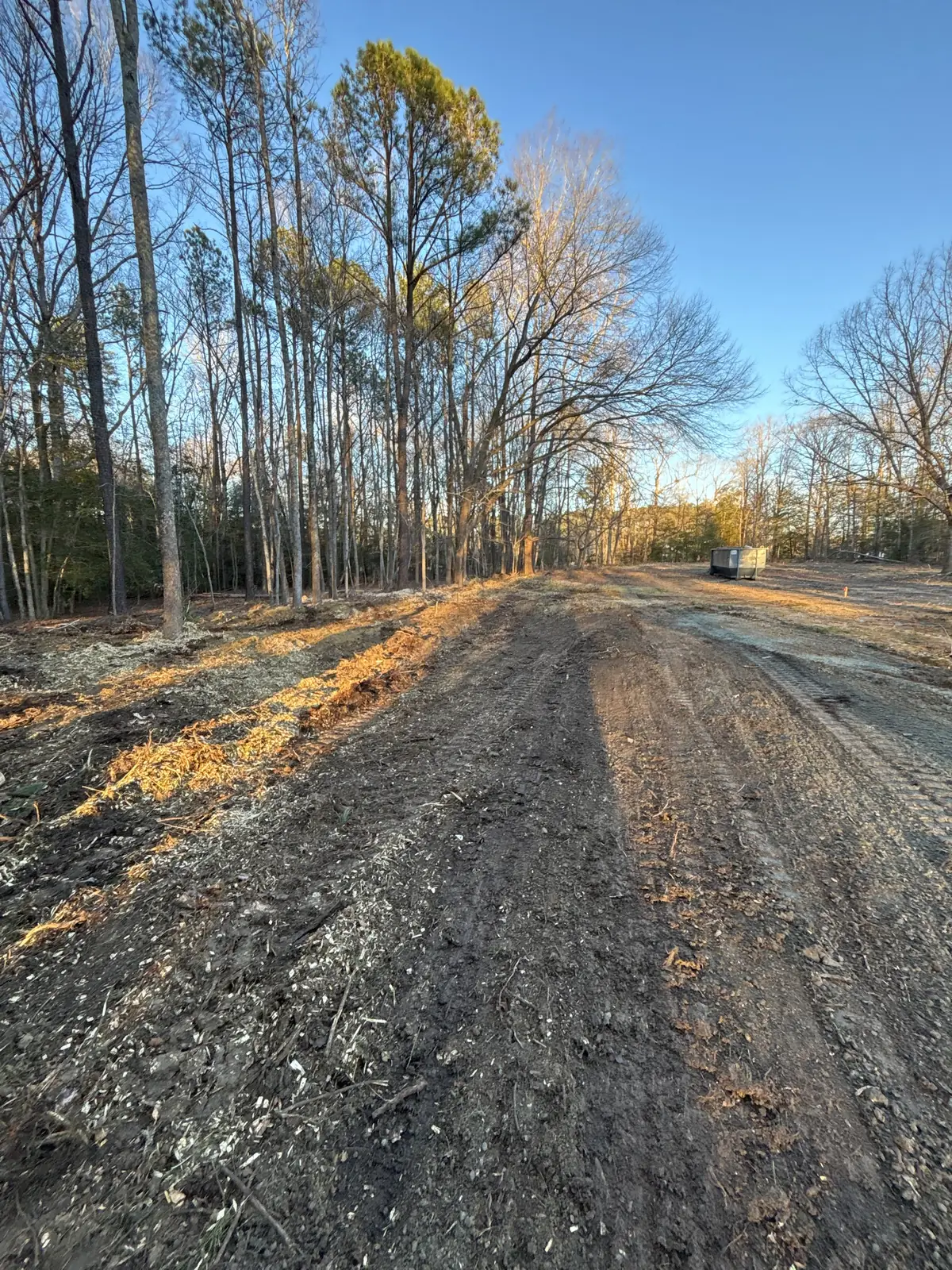
Old fields and pasture
Fields that sat a few years fill with young pine, sweetgum, briars, and vines. To bring one back, a mulcher takes down the growth and leaves the stumps low. For crop ground, contractors may follow with root raking, which pulls roots and stumps out of the soil, or drum chopping, which crushes brush and small trees with a heavy rolling drum; both appear on NC Forest Service contractor lists. Then comes disking and a soil test. The Robeson County Extension center (910-671-3276) can help with the soil test and the planting plan.
Fence lines, property lines, and ditch banks
Have the corners found before anyone clears a line; clearing on the wrong side is a neighbor problem. A mulcher opens a lane wide enough for a fence or a survey crew in one pass. On ditch banks, keep cut material out of the ditch. Inside Lumberton, it's unlawful to obstruct the city's drainage system, and anywhere, a blocked ditch floods somebody.
Hunting land
Shooting lanes, food plots, trails, and firebreaks are mulching work. Plan food plots where the soil and sun are good, and leave mast trees like oaks standing.
Which method?
| Approach | Suited to | What's left afterward |
|---|---|---|
| Bush hogging (rotary mowing) | Open ground with grass, weeds, and small saplings | Stubble, and woody stems that resprout quickly |
| Forestry mulching | Brush, plus trees up to roughly 6 to 8 inches across | Low-cut stumps under a layer of mulch |
| Root raking or drum chopping | Turning cutover or old fields back to open ground | Windrows or crushed debris; roots pulled or broken |
| Excavator or dozer | Building sites, and anywhere stumps and roots must go | Bare dirt, plus debris to handle |
Invasive plants
Freshly cleared ground invites invasives, which the NC Forest Service calls "particularly good at invading disturbed sites." The species on its list include Chinese tallowtree, tree of heaven, mimosa, Callery pear, autumn olive, bicolor and sericea lespedeza, multiflora rose, kudzu, Chinese and Japanese wisteria, Japanese honeysuckle, and Japanese stiltgrass. Mulching knocks them back but doesn't kill them. Anyone applying herbicide for pay on your land needs a state pesticide license.
Farm exemptions
- State erosion law. Agriculture is exempt from the Sedimentation Pollution Control Act, so clearing for crops or pasture doesn't need a state erosion plan.
- County zoning. The county ordinance "does not impose nor exercise any controls over croplands, timberlands, pasturelands, orchards, or idle or other farmland," and bona fide farms are exempt from the zoning permit.
- Lumberton. Inside the city's jurisdiction, "Forestry or clearing and grubbing for active farming is permitted without a permit." Developing the site within two years of clearing is treated as evidence it was cleared to develop, without a permit.
Cost-share help
The Robeson Soil and Water Conservation District (440A Caton Road, 910-739-5478 ext. 3) runs the NC Agriculture Cost Share Program, which the district says can reimburse "up to 75% of a set cost" for conservation practices under an approved contract and conservation plan. It also points landowners to federal programs, including EQIP's Longleaf Pine Initiative, which covers site prep, planting, firebreaks, prescribed burning, and invasive plant control. None of the listed programs pays for land clearing itself, and contracts come before the work, so talk to the district first if you're planning conservation work along with the clearing.
Storm-downed trees
- If a tree is touching a power line, keep away from it and call the utility.
- A tree that's under tension or leaning on a house needs a tree service with proper rigging; it isn't mulcher work.
- After the dangerous trees are handled, a mulcher or a grapple machine can take care of the rest.
- Don't count on pickup for land-clearing-sized debris. After Florence, NCDOT said only Lumberton, Red Springs, and Pembroke were collecting storm debris in Robeson County, and its contractor would "not cross onto private property."
- With permission from DEQ's regional air quality supervisor, the state air rule allows burning vegetative debris left by a hurricane, tornado, or flood, following the same conditions that apply to land-clearing fires.
What to do with the brush
- Mulch it where it lies. Then there's nothing to move or burn.
- Haul it. The county landfill near St. Pauls lists yard waste, including limbs and stumps, at $30 a ton for county residents ($45 out of county). The county's collection sites don't accept limbs, stumps, or land-clearing debris.
- Use the city pickup, inside Lumberton. The city collects limbs up to 48 inches long and 12 inches across, but only when residents do the work themselves, without a hired contractor. Stumps can't go in the rollout carts.
- Burn it, under the rules. Outside town limits, the NC Forest Service requires a permit for most burns before 4 p.m., and land-clearing fires must be 500 feet from neighbors' occupied buildings. The burn guide has the full rules.
What brush clearing costs
Many brush jobs are priced by the hour or the day, with a minimum. Knock'Em Down Solutions, which lists Lumberton in its service area, publishes $1,500 for a full day of mulching or $200 an hour with a six-hour minimum. More on cost.
Brush and field questions
Do I need a permit to clear a field for farming?
Generally not. Agriculture is exempt from the state erosion law and from county zoning, and Lumberton allows clearing for active farming without a permit. If you build there within two years, Lumberton treats the clearing as development.
How soon will it grow back?
Grass and vines may return within the same season, and sweetgum and other hardwoods sprout again from their roots and stumps. Expect to mow or spot-treat for the first year or two.
Will a contractor take a small job?
Plenty of contractors do, but with a minimum charge: getting a machine to your land costs them the same whether it works two hours or a full day. Mention up front that the job is small.
Can cost-share pay for clearing?
Not for the clearing itself, according to the Soil and Water district's program list. Some conservation practices that follow, like planting longleaf pine, may qualify. Ask the district before you start.
How we help
Phone or send a short request with where the field, fence line, or tract is, about how many acres, and what has grown up on it. One independent contractor who works in your part of Robeson County gets it, walks the land, and gives you a quote. Take the quote or leave it; either way, the referral costs you nothing.
Want a local contractor to walk your land?
Call or send a short request. There's no charge for the referral.